
Book in Focus: Paul French Reopens the Forbidden City
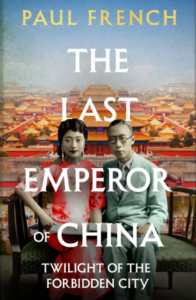
In his latest book The Last Emperor of China, British writer Paul French draws on newly surfaced diaries and letters to revisit the marriage of Puyi, the last emperor of China, and Wanrong; and the overlooked woman who witnessed their life inside the palace.
Puyi’s story seems to come pre-packaged: the child emperor, the end of the Qing dynasty, the Forbidden City and, for many, Bernardo Bertolucci’s celebrated 1987 film. But Paul French believes that this familiar picture leaves out something of value: not a grand political revelation, but the intimate, uncertain life of a young and inexperienced couple.
In The Last Emperor of China, the author revisits the years Puyi and his empress, Wanrong, spent inside the Forbidden City after their marriage in 1922. Both were 16. The Qing dynasty was gone, the republic was in turmoil, and the imperial couple retained their titles but with little political power. With his book, French asks readers to look beyond the symbols to consider what daily life and affection might have looked like behind the palace walls. Newly found diaries and letters, he says, offer a different view of the couple and of the two years they spent together before being expelled from Beijing in 1924.
A Route into China’s Past
French’s own journey into Chinese history began at school in the UK, where he had the unusual opportunity to study modern Chinese history. The subject caught his interest, and he continued with Chinese history and culture at university, then studied the language in Beijing. It set him on a path he has followed for more than 35 years, living in Shanghai for many years.
French is quick to distinguish his work from academic history, though scholarship remains central to it. He reads and cites academic research, but his ambition has always been to reach readers who might not otherwise pick up a book about China. “That meant looking at what people read – true crime, crime fiction, royal history, tales of gangsters – and try to find compelling China’s stories that would fit those genres. I just try to insert some Chinese-centred tales into that world,” he says.
French has often used figures from outside China as a way into its history, including the foreign gangsters of Shanghai, the murder of Pamela Werner, and Wallis Simpson. Such characters, he suggests, can offer a point of entry for readers who have little background in Chinese history. In The Last Emperor of China, that role belongs in part to Isabel Ingram, Wanrong’s American tutor.
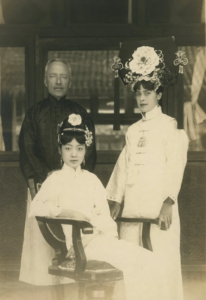
Wanrong, her tutor Isabel Ingram, and Reginald Johnston, Puyi’s tutor, 1924
The Woman Missing from The Story
Ingram has largely been eclipsed by Reginald Johnston, Puyi’s Scottish tutor, whose memoirs and later portrayals helped shape the popular image of the emperor. French says Ingram was present for the whole period the book examines: she accompanied Wanrong into the Forbidden City in 1922 and remained there until the couple’s expulsion in 2024.
French’s discovery of a cache of Ingram’s diaries and letters gave him a new view of the palace life. The papers, he says, reveal a more considerate and affectionate relationship between Puyi and Wanrong than the one usually presented. Letters from Johnston to Ingram also provide, in French’s words, a revealing and “gossipy” account of the royal household.
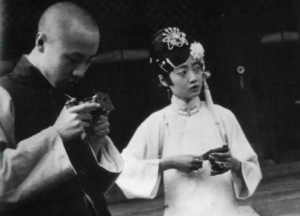
Puyi and Wanrong in the Forbidden City
The material does not turn the Forbidden City into a conventional romance. Puyi and Wanrong were young, inexperienced and isolated. Puyi had spent his life within the palace; neither had much freedom to choose the shape of their future. But, French argues, they found small ways to share a life: taking photographs, riding bicycles, watching silent films, trying foreign foods, going on picnics and dressing in Manchu and Western clothes.
Their arranged marriage, he says, was difficult, but not necessarily loveless. French’s account places ordinary pleasures alongside the familiar political drama—and makes the couple’s later suffering all the more poignant, especially Wanrong’s early and tragic death.
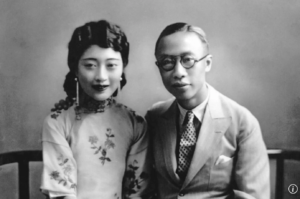
Puyi and Wanrong
From Palace Isolation to Political Vulnerability
For French, Puyi’s time in the Forbidden City also matters because it helps explain what came later. Puyi was not simply a deposed monarch watching history pass. He remained a potent symbol, even as he was increasingly detached from the realities of the country around him.
French points to the young republic’s instability, the power of the warlords and Japan’s growing interference. Puyi, he argues, was badly advised and isolated from daily life in China. Those circumstances help explain how he could later be manipulated by the Japanese, become emperor of Manchukuo, the state established under Japanese occupation, and collaborate with Japan during the Second World War.
Puyi was, French says, “a relic, a left behind item from a feudal dynastical past”, but one who still had political value. The contrast between his diminished power and enduring symbolic importance is central to French’s account of the last emperor’s life.
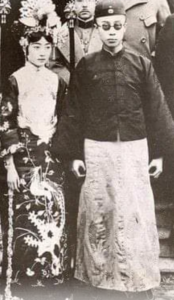
Puyi and Wanrong
For academic readers, the book’s appeal lies partly in its sources: Ingram’s diaries and letters, Johnston’s correspondence, and the details they offer about the household and the unsettled China of the 1920s. For newcomers, French offers a story that is striking in its outline alone: a boy made emperor at three, forced to abdicate at six, confined to the Forbidden City, married at 16 to a girl he had never seen, and expelled into the wider world at 18. Puyi lived until the 1960s – a long life beyond the moment when many might assume his story ended.
Looking for Hong Kong’s “White Whale”
French’s interests have also taken him to Hong Kong many times since his first visit in the 1990s, often for the Hong Kong International Literary Festival. He speaks warmly of the city and of the readers and booksellers who have supported his work.
He has written about 1920s Hong Kong in Her Lotus Year (2024), his book about Wallis Simpson’s time in China. “I’ll admit when I started that book I knew she had been in Shanghai and Beijing but not that she arrived and spent a few months in Hong Kong. And I did enjoy that experience,” he says.
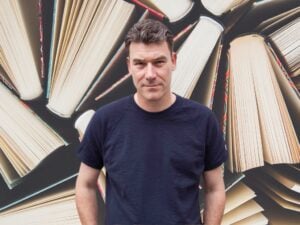
Paul French
Hong Kong has not yet become the subject of a book of its own. French is still looking for the right story: the one that would make him “drop everything” and write. He compares the search to Captain Ahab’s pursuit of the white whale in Moby Dick. The story, he believes, is out there.
Paul French, The Last Emperor of China, Twilight of the Forbidden City
301 pages, Elliott and Thompson. Available at Bookazine and Online.